Perspectives
Your place to explore new perspectives on British art from 1900 to now. Through interviews, films, image galleries and essays, we uncover the creative lives of the people behind the art on our walls.
In Conversation with Paintings Conservator Sophie Reddington
[ Stories )
As part of preparations for British Landscapes: A Sense of Place, we spoke with paintings conservator Sophie Reddington, who has been working behind the scenes to prepare several important works from Pallant House Gallery’s own collection for display in the exhibition. From stabilising fragile paint surfaces to uncovering long-hidden colour, her work plays a vital role in how we experience these much-loved paintings today.Q: What are you currently working on?
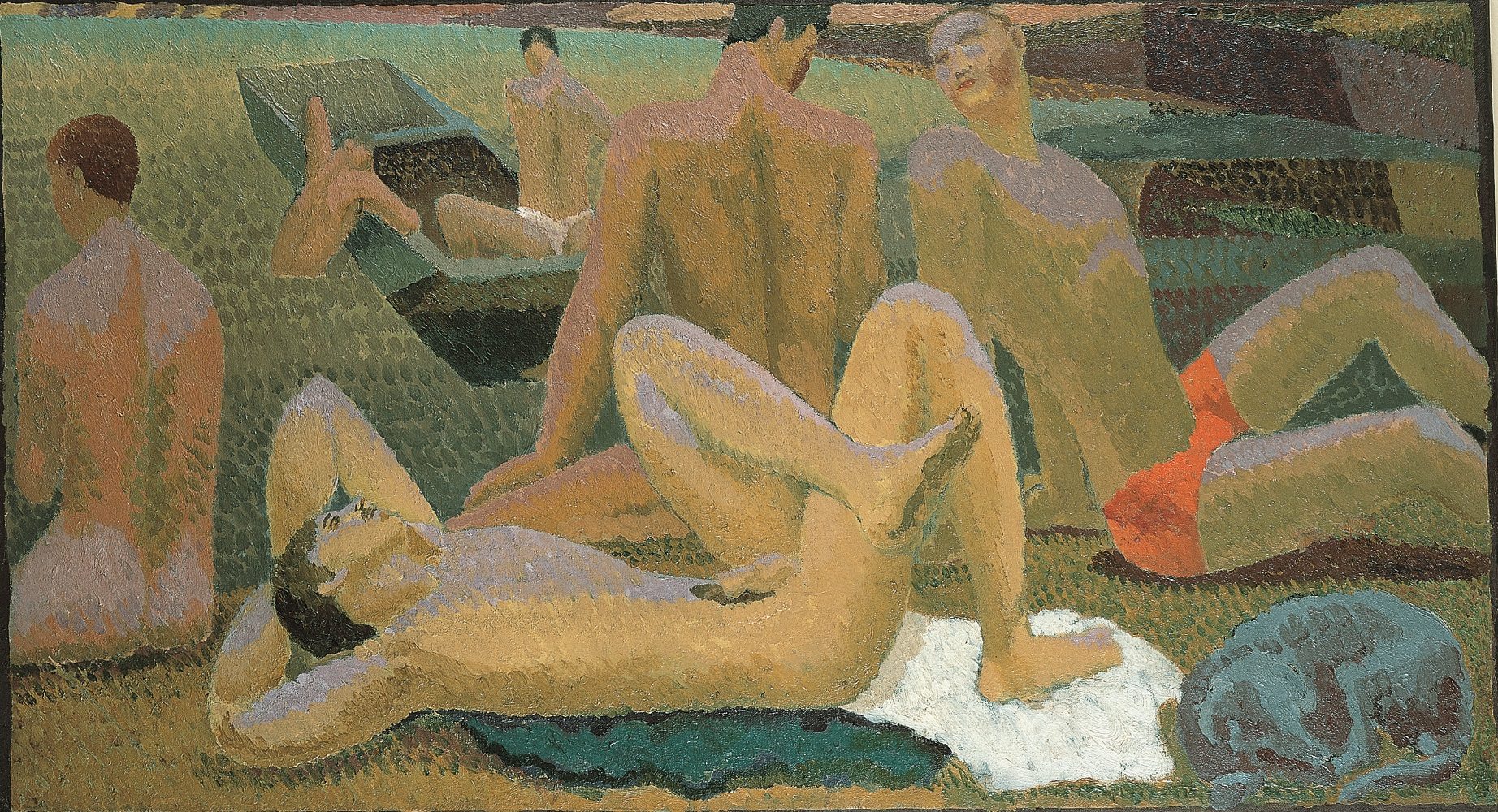
A: I’m working on Bathers by the Pond (c. 1920-01) by Duncan Grant. When I first assessed the painting a couple of months ago, I could see that the paint surface was quite vulnerable in places. There are areas where the paint is lifting, so my priority is to stabilise it, both for display here and because it will be going on loan to Tate Britain for another exhibition afterwards.
This felt like a good opportunity to properly examine and treat the painting, making sure it’s safe for the future.
Q: What’s the first thing you look for when assessing a painting?
A: The first thing is always: how fragile is it? I look closely at the paint layers – whether they’re stable, whether there’s surface dirt or dust, or any signs of damage.
When I know a work is going on display, I examine it under magnification. That allows me to spot things like tiny abrasions, old paint losses or weakened edges. In this case, I also found some old glue that had aged badly and become brittle. I removed that and replaced it with a conservation-grade adhesive to improve the condition.
Q: What other kinds of issues did you find in Bathers by the Pond?
A: It’s quite a delicate painting. There are many areas of old damage that have been retouched over time, which tells us that conservators have returned to them more than once.
It’s one of those works that needs ongoing care – regular observation to make sure it stays stable. Under magnification, I also noticed very small, discoloured retouchings scattered across the surface. Visitors wouldn’t see these, but they’re important for us to understand how the painting has aged.
Q: How do you treat fragile paint like this?
A: I use a conservation adhesive that’s been developed and tested over decades. It flows into the cracks and helps secure lifting paint.
I carefully apply it to areas where the paint is raised, remove any excess, and let it dry. Then I go back in with a heated spatula – like a miniature iron – and use gentle heat and pressure to settle the paint back down. That helps keep it in place long-term.

Q: What other tools are essential to your work?
A: Magnification is key, so we use Optivisors to examine the surface in detail. They may not look glamorous, but they’re incredibly effective.
The heated spatula is an essential tool. It allows us to gently re-adhere lifting paint. We also use small, specially designed weights to hold areas in place as they dry, without putting too much pressure on the surface.
Q: How do you decide what treatment a painting needs?
A: The most important principle is preserving the artist’s intent.
For example, many modern and contemporary artists chose not to varnish their paintings. In those cases, I would never add varnish. In fact, I often find myself removing varnish that was previously applied.
If a painting was originally varnished and that varnish has degraded, it can distort the appearance. Removing it and replacing it with a more stable layer can make a huge difference – it can really bring the painting back to life.
Q: What do you enjoy about working on Duncan Grant’s paintings?
A: I’ve worked on several of Duncan Grant’s paintings, and I always love them. The paint layers are often quite delicate, with beautiful impasto and really vibrant colours.
Often, when they come into the studio, they’re quite dirty. Cleaning them is incredibly satisfying, you reveal the texture again and the colours become vivid. It’s like seeing the painting anew.
Q: What’s the most rewarding part of conservation?
A: Bringing an artwork back to life.
Many works haven’t had the care or resources they need over time. By cleaning them or removing old restorations that haven’t aged well, we can reveal something much closer to what the artist intended.
And, of course, it’s about ensuring these works are preserved for future generations.
Q: What drew you to conservation?
A: I originally wanted to be an artist. I loved painting and drawing, but I felt that to succeed as an artist you have to be exceptionally talented.
Conservation felt like the next best thing. I may not be making art myself, but I’m constantly surrounded by it and working very closely with it.
Q: What’s been one of your most memorable projects?
A: Working on two paintings by Joshua Reynolds at Petworth House.
They were incredibly challenging. The paintings were so obscured by layers of aged varnish that they were almost unreadable. One was enormous, we had to roll it onto a tube to remove it from the house, transport it to the studio, and then spend hundreds of hours treating it.
It felt more like an excavation than a restoration. Reynolds was very experimental with his materials, so you never quite know how far you can safely go. It was nerve-wracking at times, but ultimately very rewarding.

Q: Are you working on any other pieces for the exhibition?
A: Yes, a few others including an ice-skating scene on Hampstead Heath by Christopher Wood.
Seeing it out of its frame is quite striking – it looks much smaller. The surface has a noticeable yellowing, partly from varnish but also from nicotine. A light surface clean will make a big difference, bringing out the figures and giving the painting more depth.
Conservation is often invisible to visitors, but it plays a crucial role in how we encounter paintings in the Gallery and ensuring they can be enjoyed for years to come. Thanks to this careful work, paintings like Duncan Grant’s Bathers by the Pond and Christopher Wood’s Skaters at Hampstead can be seen with greater clarity with colours refreshed, surfaces stabilised, and details brought back into view. See them for yourself this summer in British Landscapes: A Sense of Place at Pallant House Gallery.