Perspectives
Your place to explore new perspectives on British art from 1900 to now. Through interviews, films, image galleries and essays, we uncover the creative lives of the people behind the art on our walls.

Haroun Hayward in Conversation: Path through Trees
[ Artist Interview )
Now open at Pallant House Gallery, Path through Trees is a new exhibition by artist Haroun Hayward. Bringing together painting, music, landscape and memory, the works draw on a wide range of influences, from postwar British painting and South Asian and West African textiles to Detroit techno and 1990s rave culture. In this conversation, Hayward reflects on the ideas behind the exhibition, the personal experiences that shaped it, and the connections between sound, pattern and place that run throughout the work.
The title Path through Trees feels very evocative. How did it come about?
It’s a subtitle of a Paul Nash watercolour called The Wanderer and it came about in quite an organic way. A lot of the things that end up in the paintings as references or titles are based on my experience of living and thinking about the work beforehand.
During my residency at Pallant House Gallery, I was going on these long walks at West Dean College every evening. They have this amazing tree garden and the threshold of the tree garden looks a certain way, and past that point I wouldn’t take photographs. I felt there was an energy there that was very personal.
But I was taking photos of the threshold every day and sending them to a family WhatsApp group. My mum, who is a huge influence on me and a big reason why I make art was in a charity shop some days later and she was amazed to find a cover of a watercolour book that looked like the photos I’d been sending her of the threshold to this garden.
To her delight (and mine), she opened it and discovered that it was quite an unknown Paul Nash watercolour. That connection felt quite magical, especially as Paul Nash is such a significant influence on this exhibition, so it made sense to call it Path through Trees.
There’s also a little in-joke there because a lot of my work is to do with British rave culture, and if you used to go raving in the countryside, you’d often find yourself walking on a path through trees, a little bit squiffy in the morning or the evening.

Many of the artists referenced in the exhibition are represented in Pallant House Gallery’s collection. How did that shape the exhibition?
I mean the general concept started when Melanie (Chief Curator at Pallant House Gallery) saw my work at Hales Gallery some time ago and was interested in it generally. She then discovered that a lot of my references for some years have been about the postwar landscape era and specifically artists such as Graham Sutherland, Paul Nash, Wilhelmina Barns-Graham, and Edward Burra, all of whom are in the Pallant House Gallery collection and all of whom are in the British Landscapes: A Sense of Place exhibition alongside mine.
So that felt very organic and spiritually resonant for me.
During my residency, I spent a month in the archives here at the Gallery, which was a real treat for me because I’ve been studying some of these paintings since I was a child. In the new work I made for the exhibition, however, I make a point of not referencing the specific works the Gallery has on display, because there can be a tendency to compare and contrast in a way that can be a little reductive.
I think I’ve got the tone and style of lots of the artists and I do reference works that they have made, but not so much directly taking from the collection in terms of what you’ll see. That’s except for the cope designs by the artist Ceri Richards. These were my biggest revelation during my time here because I’ve never been the hugest fan of his paintings, but when I discovered his cope designs, I thought they were his greatest works.
To discover those hidden away here in this archive felt magical and they’re directly translated in some of the paintings that you’ll see.

Your work brings together landscape painting, electronic music and textiles. How do those references come together?
I grew up in a house surrounded by textiles, so it’s always been on the periphery of my practice. The idea of pattern and rhythm in electronic music relating that to pattern and rhythm in Indo-Persian textile is actually quite straightforward. Once I explain it and people see it, it makes sense. I developed a technique to emulate thread, but with oil stick, which is just very appealing to experience and make – there’s a tactility to it.
A lot of what I talk about comes from living with these influences rather than from intellectual pursuit.
There’s a connection between British rave culture in the 1990s and its countercultural ethos. It may not seem obvious now, but British landscape painting was quite avant-garde in its time and there is a link between that and punk, and to the acid house generation and that kind of ACAB and squat parties and free parties… I think it is all a very English type of rebellion.
Can you talk us through how the paintings are constructed?
I do a lot of drawings. Everything comes from sketching, which I’d say is integral to everything I do. It always starts with an imprecise sketch that in fact looks nothing like the finished piece, and then I build from that.
There isn’t really a predisposed idea or pattern to how I construct the works. It all comes quite organically. I’ve always been a bit of a magpie and I get a bit bored doing just one thing.
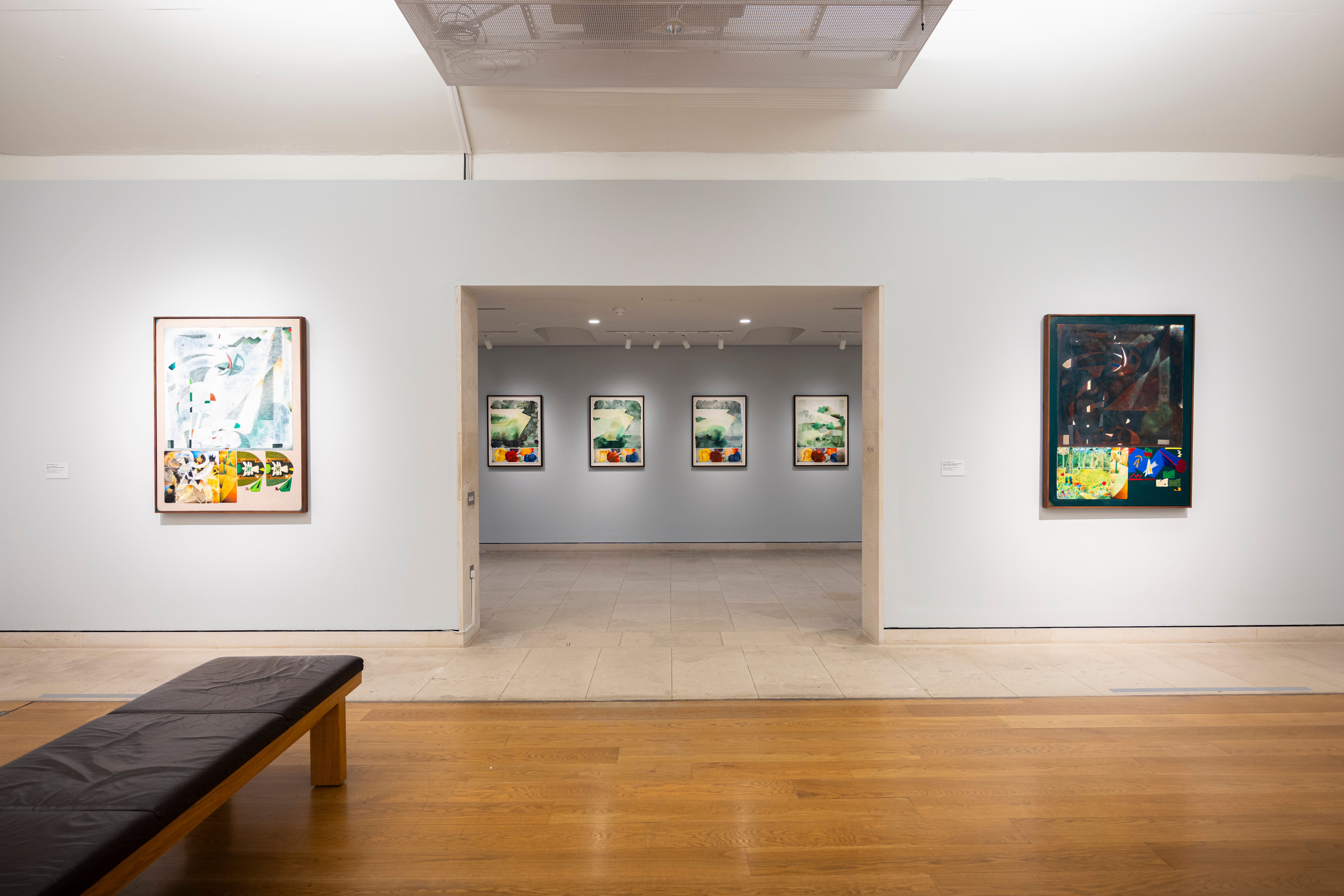
Making something cohesive that is made of disparate parts is really appealing to me. A lot of it is informed by my Synaesthesia, so the top part of each panel has an abstract painting that is informed partly by a Wilhelmina Barns-Graham etching from her Glacier series, but then partly by me just listening to techno and kind of feeling and seeing energy and shapes.
So that comes first, then I relate that to a landscape, and then those two parts inform the Suzani or the textile parts on the bottom right.
You’ve spoken before about wanting the work to bring people joy. Why is that important to you?
I think it’s everything, but also it can be a little bit reductive because as much as I do love being an artist and making the paintings, work is still work and these are very labour-intensive pieces. So not every moment is this kind of ecstatic, joyous experience.
But overall, especially as I’ve had time away from the art world, as a cook and caring for family, I’m extra conscious of the privilege of what this is and the joy of being able to paint every day.
I’ve said this before in an interview, and I’ll say it again, I think if you come into the space I’ve curated of my work and your first reaction or response is to say, “Tell me more”, then I feel I might have failed.
I think that the first thing should just be a feeling of joy or a feeling of wanting to be in the space and then once you have felt that, you can say, “Tell me more”.
I often think when people who don’t know anything about the references or even children connect with the works, then they’re quite successful in my eyes.
Haroun Hayward: Path through Trees in on show until 1 November 2026.

